
India's heavy-lift rocket GSLV MkIII, carrying communication satellite GSAT-19.

A recap of events that occurred in India in the past 24 hours.

The stage is set for the launch of India's satellite IRNSS-1D on Saturday from Sriharikota onboard workhorse PSLV-C27 that would pave the way for the country's own navigation system on par with the GPS of United States.

PSLV C-29 blasted off from the Satish Dhawan Space Centre, about 110 km from Chennai, at 6 pm and released the six satellites one by one into a 550 km circular orbit.
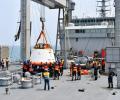
Nerves gave way to smiles at the spaceport in Sriharikota as delays and an anomaly-triggered 'hold' forced Indian Space Research Organisation (ISRO) scientists to revise the launch schedule of a test vehicle carrying payloads related to the country's ambitious human space flight mission, Gaganyaan which soared into skies after initial hiccups.

The RISAT-2B would replace the RISAT-2, which has been actively used by India to monitor activities in camps across the border in Pakistan to thwart infiltration bids by terrorists.

According to his family friends, Narasimha was in the league of the Missile Man of India and former president Dr A P J Abdul Kalam.

After having successfully completed three orbit raising manoeuvres, ISRO's Mars Orbiter mission on Monday suffered a glitch as it failed to achieve the targeted apogee (farthest distance from Earth) of one lakh km during the fourth orbit raising operation in the early hours.
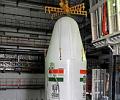
The launch of a Geosynchronous Satellite Launch Vehicle was called off by the Indian Space Reasearch Organisation at the eleventh hour on Monday due to a fuel leak in its second stage -- in a setback to the mission to test its homegrown cryogenic engine -- after its failure three years ago.

The ISRO is aiming for a soft landing of the lander in the South Pole region of the moon where no country has gone so far.

ISRO Chairman K Sivan said there might by a postponement if the weather was not conducive.
Godrej and some other firms are frustrated at what they say is the slow execution of projects and lack of government support, which are hampering India's efforts to compete with China and Russia as a cheaper option for launching satellites.
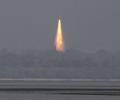
Enthused over its successful launch of GSLV D5 with GSAT-14 communication satellite from Satish Dhawan Space Centre in Sriharikota on Sunday, the Indian Space Research Organisation is planning a series of GSLV launches and an experimental launch of the advanced version GSLV Mark III soon from the spaceport.

Indian skipper Virat Kohli, on Monday, lauded ace sprinter Hima Das for winning five gold medals in a span of 20 days.

This is the first mission by the Indian Speace Research Organisation this year.

Chandrayaan 3 follows the Chandrayaan 2 mission which did not achieve the desired soft landing on the surface of the moon in 2019, disappointing the scientists.

Other than the Cartosat-2 series satellite, the PSLV is carrying 29 nano satellites from 14 countries - Austria, Belgium, Chile, Czech Republic, Finland, France, Germany, Italy, Japan, Latvia, Lithuania, Slovakia, the United Kingdom and the United States of America besides a nano satellite from India.

The first Trajectory Correction Manoeuvre of India's maiden mission to Mars was on Wednesday carried out successfully by Indian Space Research Organisation scientists on the spacecraft, which is presently travelling some 2.9 million km away from Earth.

Indian Space Research Organisation will announce a revised launch date later.

Microsat-R, an imaging satellite, is meant for military purposes, but the ISRO did not give any details about it.

It also carries equipment for meteorological data relay and satellite based search and rescue services being provided by earlier INSAT satellites.

Contributors to Team Indus project will have names etched on an object going to space.

The space agency launched 104 satellites, breaking the previous record of 37 by Russia.
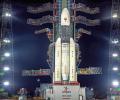
Late on Monday night, in a last-minute revision of schedule, ISRO announced that the launch of India's second lunar mission 'Chandrayaan-2' has been called off due to a technical snag.

The satellite would provide a thrust to mobile communication through multi-beam coverage facility, the ISRO said.

In a textbook mission, ISRO's PSLV-C32 lifted off from Sriharikota and later injected the IRNSS-IF in sub-Geosynchronous Transfer Orbit.

The primary goal of HysIS, whose mission life is five years, is to study the earth's surface in visible near infrared and shortwave infrared regions of the electromagnetic spectrum.

He said India wanted growth, development and peace in the region and was keen to utilise technology to pursue this goal for the shared prosperity.

The feat is the second one for the Indian Space Research Organisation scientists in using the indigenously made cryogenic stage after the January 5, 2014 launch of GSLV-D5.

India is set to operationalise its own navigational system with the successful launch of IRNSS-1D, the fourth in the series of seven navigational satellites, onboard PSLV-C27 from Sriharikota on Saturday.

The Indian Space Research Organisation successfully launched India's fifth navigation satellite IRNSS-1E from Sriharikota.
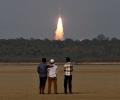
'The goal seems to be that we do not invest further in our system to make our system more accurate and more reliable or more global in reach,' an ISRO source tells Shivanand Kanavi.

The successful orbiting of the satellites by the Polar Satellite Launch Vehicle PSLV C-40 comes four months after the Indian space Research Organisation's mission to launch backup navigation spacecraft IRNSS-1H onboard PSLV-39 ended in a rare failure.
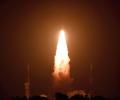
A S Kiran Kumar, chief of ISRO, said the mission was unsuccessful because the satellite housed within the heat sink could not be injected.

The GSAT-31 is a 'high power' communication satellite going to serve and replace some of the satellites that are going to expire soon.

'You declare a date, time and place for the landing two months in advance and exactly at that moment, it touched on the moon.'

In a landmark late Monday night journey into a new era of space application, India successfully launched its first dedicated navigation satellite using the Polar Satellite Launch Vehicle which blasted off from the Satish Dhawan Space Centre.

'What we have done is a symbol of new India; that is what a small start-up can do, a few hundreds of people coming together, developing a rocket and launching to space and succeeding at the very first attempt.'

I suggest we build a Vigyan Mandir (Temple of Science) with the ambience of a place of worship, so that it becomes a destination for pilgrims. We should embed on its walls bronze plaques describing each scientist mentioned here along with about a dozen of our ancient mathematicians, recommends Professor Kalyan Singhal, historian of science and technology.

The Rs 978 crore mission, which has been rescheduled for Monday after scientists corrected the glitch in the rocket, will be launched at 2.43 p.m from the second launchpad at Satish Dhawan Space Centre, over 100 km from Chennai.
